Laser welding has been used in the automotive industry for forty years. In 1975, Fiat installed a CO2 laser for welding transmission components. Today, thousands of companies around the world are reaping the benefits of this process.
And while the Germans have traditionally been its most ardent advocates, it has since been widely adopted by automakers of all nationalities, as well as by companies of all sizes and across numerous industries in Europe, the Americas, and Asia. It’s worth noting that China is one of the largest buyers of laser welding systems—which gives us something to think about…
From disposable razor blades to vehicles, pipes, and woodworking tools, everyone comes into contact with laser-welded objects on a daily basis, often without even realizing it. Despite the limited awareness of this technology within much of the industry, laser welding is a mature, proven process.
Laser Welding
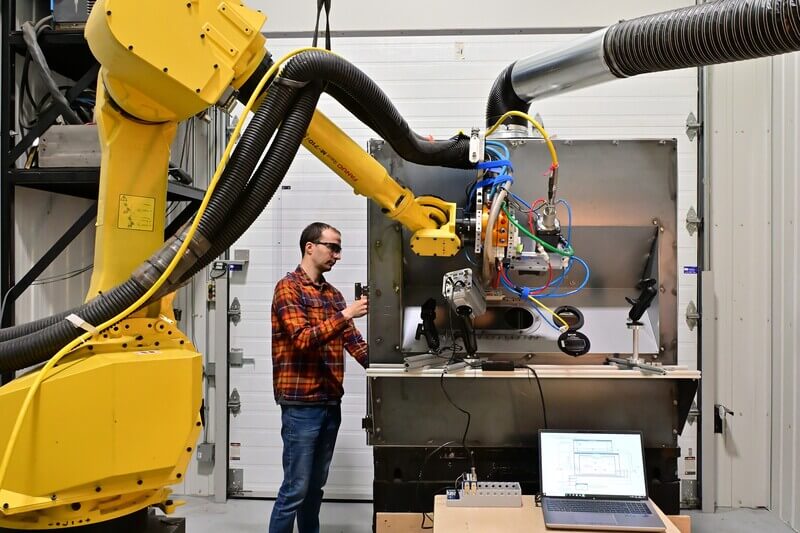
In the metal fabrication industry, laser welding is typically performed using an infrared laser source. The beam is therefore invisible and poses a real safety hazard to workers. As a result, special precautions must be taken. Whether welding is performed by a robot (or any other manipulator) or manually, it must be carried out in a secure enclosure by personnel trained in laser hazards. In the case of manual welding, wearing PPE suitable for laser exposure is essential.
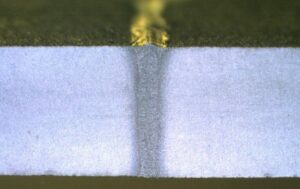
Laser welding can be performed in two modes: conduction or keyhole. Conduction welding is performed in the liquid state and requires a power density of approximately 10⁵ W/cm². Keyhole welding, on the other hand, involves the vaporization of the metal under a power density of at least 10⁶ W/cm².

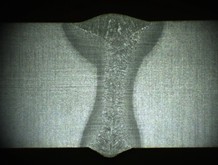
The capillary—a small “tube” of metal vapor that forms within the workpiece—enables the creation of a weld with the narrow, deep profile typical of laser welding (see image opposite), whereas conduction welding produces welds that are wider than they are deep.
Given that, in industrial applications, the diameter of the laser beam striking the material is approximately half a millimeter, a laser source rated at several kilowatts is most often required for keyhole welding.
The Advantages
When it comes to productivity, laser welding is second to none… While it is common to laser weld at 5 m/min, some applications use speeds of 20 m/min…
Thanks to the laser’s high precision and the minimal heat transferred to the workpieces, it is possible to significantly improve product quality. As proof, the heat-affected zone (HAZ) is virtually nonexistent. Narrow welds, no spatter, no distortion—say goodbye to polishing and straightening! Furthermore, the mechanical properties of the welded metals are not significantly degraded by the process; it is therefore no longer necessary to increase the thickness of the materials to compensate for the mechanical weakness of the welds.

But the list of advantages doesn’t stop there. Laser welding opens the door to products that were previously impossible to produce. Transparent welding (i.e., “passing through” the top piece) opens the door to new designs. The ability to join different materials (e.g., copper and stainless steel, etc.) also offers opportunities for aesthetic and functional innovations. Finally, the ability to produce welds that are both thin and leakproof makes this process the obvious choice for certain applications.
Equipment
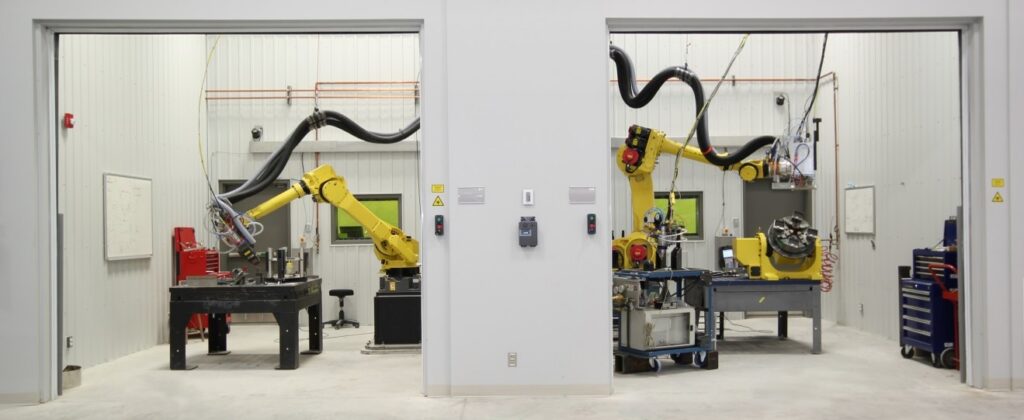
The cost of laser infrastructure is comparable to that of industrial-grade digital equipment (cutting machines, press brakes, etc.). The price of laser sources and robots has dropped significantly over the years, making the process more widely accessible. Furthermore, this process is most often carried out without the need for additional materials and sometimes without shielding gas; as a result, operating costs are remarkably low.
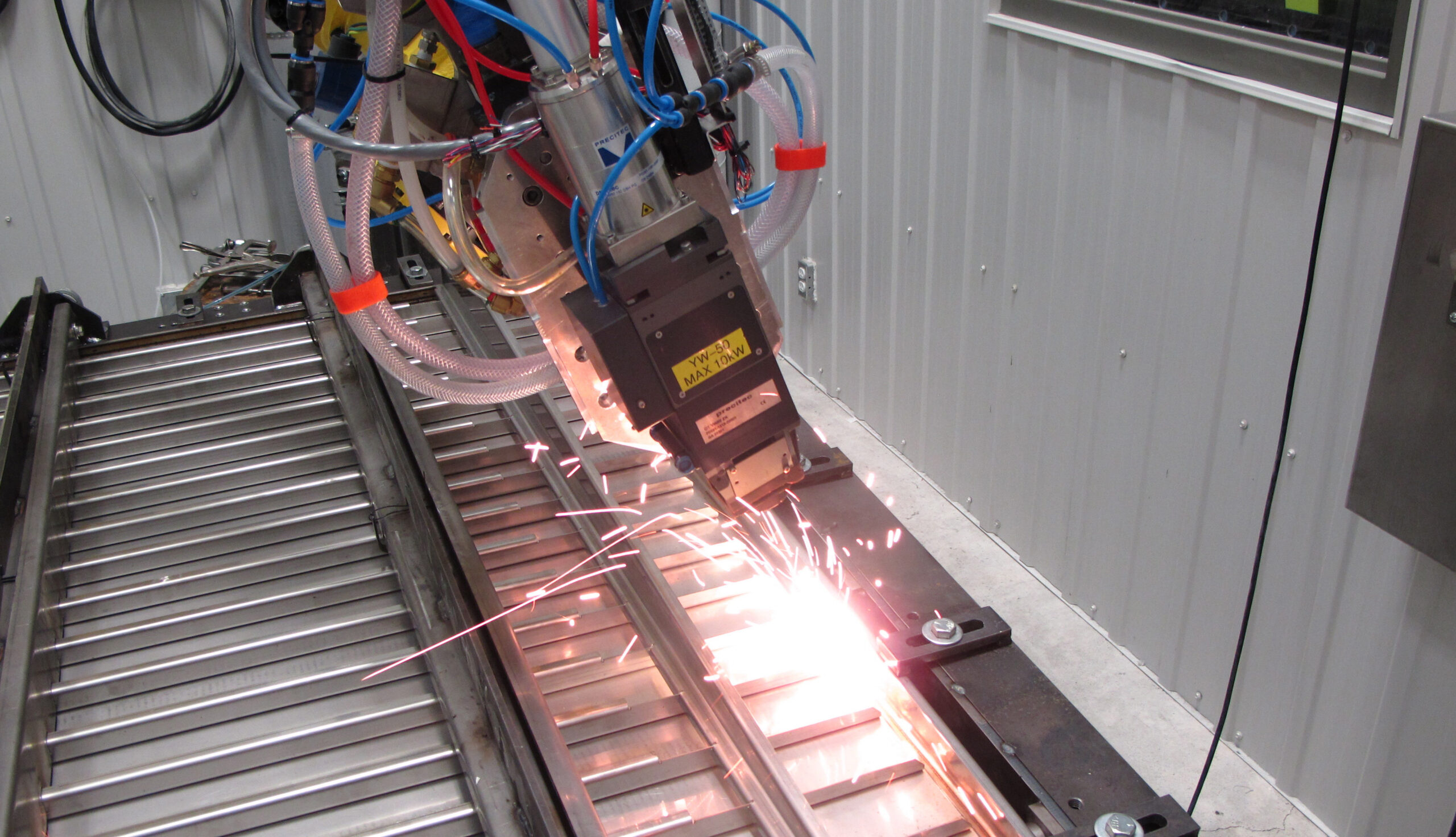
Once generated, the near-infrared laser beam is then transmitted via optical fiber to the workpiece, sometimes up to 200 meters away!
Application of the Process
Most common metallic materials can be laser-welded: steel, stainless steel, aluminum, thermoplastics, titanium, copper, etc. Some require certain precautions (managing reflections for copper and aluminum, adding filler wire for certain aluminum alloys, etc.), but the process generally remains simple and cost-effective.
One of the main challenges in the industrialization of laser welding is related to the tight tolerance on the gap between parts. Since in most cases no filler material is used, good contact between the parts to be joined must be ensured. For a butt joint, the maximum gap is on the order of one-tenth of the thickness of the parts to be joined. Inspection of the preparation of the parts to be welded must therefore be particularly rigorous. In such situations, a transparent welding is often chosen, for which the straightness of the part edges is not critical.
To fully benefit from the advantages of the process, it is often preferable to adapt the design of the assemblies accordingly. Laser welding a part designed for another process generally limits gains in productivity and quality. Furthermore, a basic understanding of laser welding allows for the necessary adjustments to be made to the joints to be produced.
Operating and monitoring a laser welding system does not require hiring highly qualified personnel. While it is helpful to have access to a specialist who can address occasional specific needs, a CNC machine operator can easily handle the production of welded assemblies. A well-planned integration and proper staff training will help avoid the most common potential problems.
Uses of Gases
In laser welding, gases are primarily used for three reasons: to protect optical components, to suppress plasma to ensure good stability, and to improve joint quality (by controlling oxidation, porosity, etc.). Optical components are generally protected using a jet of clean air directed parallel to the surface of the workpiece. This deflects fumes and spatter before they reach the optics.
The formation of plasma through the ionization of metal vapors and the shielding gas is a phenomenon to be avoided in laser welding. In fact, under certain circumstances, the plasma can deflect and absorb the beam. The most common shielding gas in laser welding is argon, primarily because of its effectiveness in preventing oxidation, its affordability, and its ease of use (good coverage of the molten pool due to a higher density than that of air).
In addition, nitrogen can also be a beneficial choice due to its low cost. The narrow, deep profile of the keyhole joint and the very short solidification time (a fraction of a second) prevent iron from reacting significantly with nitrogen. Problems related to nitride formation are thus avoided.
Finally, for many applications, no shielding gas is used, as the surface area of the welding pool exposed to ambient air is very small and the interaction is limited to a fraction of a second.
Hybrid Welding

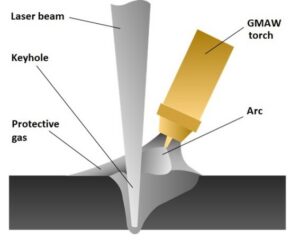
A variant of laser welding allows for the welding of thick materials; this is known as hybrid laser-arc welding (HLAW). This process combines an electric arc and a laser beam within the same molten pool using, for example, a semi-automatic GMAW welder with solid wire and a laser welding head. The ability to join thick plates without preparation and in a single pass has contributed to the growing interest for this technology on the global market! The first industrial applications of hybrid welding included, among others, the welding of ships, structures, and automotive components.
The advantages of this process are numerous and truly impressive. The first thing that comes to mind is the increase in productivity. For a 12-mm butt-welded plate, it is estimated that hybrid welding will reduce welding time by 90%, not counting the other operations that are completely eliminated. In addition, hybrid welding yields considerable savings on consumables (wire, gas, etc.): from a 50% savings for thin parts (4 mm) to over 90% for 12 mm parts! And, importantly, hybrid welding often eliminates the need for part preparation operations: no more beveling…
By introducing less heat into the parts than conventional processes, hybrid welding has much less impact on the metal’s mechanical properties. In many cases, hybrid welding allows the use of thinner base metals for the same joint strength, thanks to improved mechanical properties (the weld is the weak link in a standard welded joint). With the rising cost of steel and pressure from various industries for lighter products, this consideration is becoming increasingly important.
Finally, since the parts are subjected to less heat, they have lower residual stresses and remain closer to their theoretical dimensions (they are less distorted). It is therefore often possible to eliminate stress-relief and straightening operations, which results in significant cost reduction.
In conclusion…
Thanks to its speed, precision, and flexibility, laser welding significantly increases productivity and the quality of assemblies. Since the cost of equipment has dropped significantly in recent years, it is now accessible and cost-effective for many companies.
Novika offers services in information, parameter development, technology transfer, and training on laser welding. If you have any questions on this topic, please contact: